In the rapidly evolving world of autonomous AI agents, security isn’t just a runtime concern, it’s a foundational requirement that must span the entire lifecycle. Traditional “deny-by-default” (or whitelist-only) models have long protected production environments by blocking everything except explicitly approved actions. NVIDIA’s groundbreaking OpenShell runtime and NemoClaw reference stack take this principle to the agent execution layer with kernel-level sandboxing, declarative YAML policies, and explicit controls over network requests, file access, and inference calls.

But as any cybersecurity expert will tell you, every layer of the stack must be secured. Instead of securing the run-time only, you need to secure the software supply chain, the tools and components your AI is built on, and you must secure the build process:
"Google’s overall approach to supply-chain security is to support Supply-chain Levels for Software Artifacts (SLSA), supplemented by software bills of materials (SBOM), and we carry that forward to AI." – Phil Venables, Chief Information Security Officer (CISO), Google Cloud
Unfortunately, software that is vibe coded from an LLM achieves none of these supply-chain and build process security checks. There is no provenance tracking, dependency checking, secret scanning, pre-deployment review, etc.
And even if the resulting agent is 100% secure, there is a very good chance that it takes actions that could put a company and its data at risk. For example, exposing market moving quarterly financial data to the company’s CFO might be “secure”, but exposing that same data to the rest of the company could invite insider trading at a mass scale.
Firewalls use a combination of blacklisting and whitelisting. Blacklisting is meant to stop “bad things”, but this is a constant battle of spy vs. spy to discover and prevent new bad things. The complementary approach is whitelisting which enables only pre-approved “good things”.
NemoClaw’s OpenShell takes a proactive whitelist or deny-by-default approach using sandboxing, allowing only whitelisted actions and network egress, and overlaying inference routing to avoid shady LLMs. This applies run-time security best practices.
Only by combining this with similar whitelisting at the supply chain and build processes, can you offer end-to-end security. ComponentFactory.ai secures the supply chain and the build process using SLSA Level 3 security. Each agentic AI building block contains its provenance that is generated by the system and easily authenticated. The build process is scripted, automated, isolated, and ephemeral. The source is version controlled, has a verified history, and is retained indefinitely. This addresses your AI supply chain. It shifts the AI model from vibe coding to vibe assembly of tested and validated AI building blocks (components).
This is a massive improvement, but it is still insufficient for enterprise customers. They need the ability to review, secure, and approve each component according to their security policy. Freshly hallucinated code will never achieve this. They need to create their own component repository based on validated components that comply with their security policies. Then, and only then, can the agents or humans assemble agents composed solely of these “whitelisted” agentic components. Without this end-to-end solution, enterprise customers will dabble with agents in their labs, but they won’t deploy them en masse. The risk is simply too high.
While NemoClaw’s OpenShell focuses on securing agents at run-time, ComponentFactory focuses on the agentic supply chain and enabling a secure build process. ComponentFactory has two technologies that fit into this enterprise-friendly ecosystem:
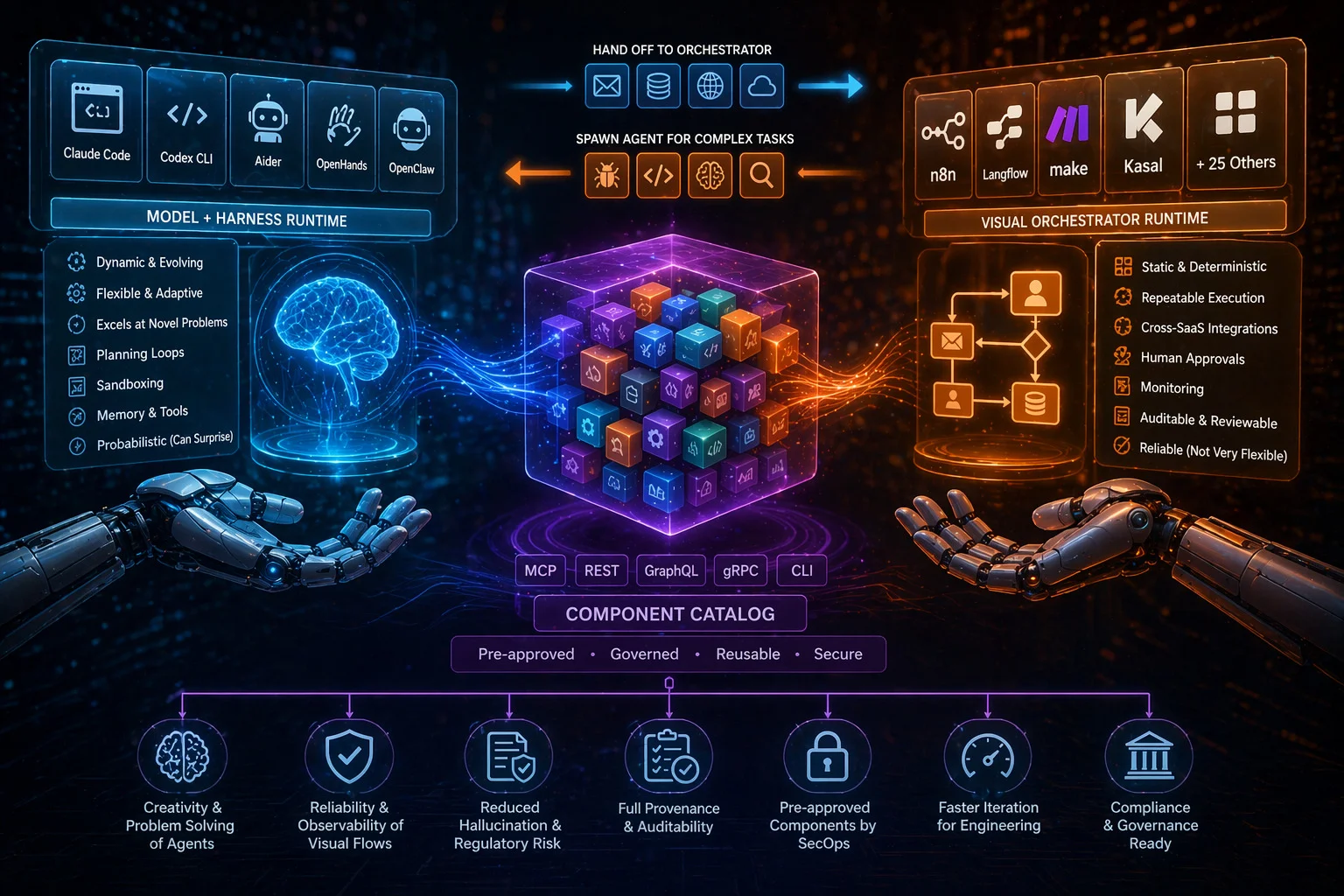
When creating a brand new component using ComponentFactory, it is no better than fresh AI-generated code. The community, through the ComponentCatalog is what validates and hardens the component. More usage, and eyes on each component, means more security, fewer fix cycles, and better code.
When a user cannot find a component that addresses 100% of their needs, they may find one that addresses a substantial portion of their needs, say 95%. By starting with that proven component and making only incremental changes to address the missing 5%, the resulting component is far more tested and proven than freshly generated code.
Enterprises can take these components and create a curated subset that they approve. This may require additional changes to comply with their security policy. This set of whitelisted components can then be reused by humans or agents to assemble agents and subagents without fear of rogue behavior.
Enterprises also benefit from the community validation process, even for their whitelisted components. For example, a library or API (dependency) used by a component may be updated. The community quickly updates the base component. The Enterprise can then take that updated base component, infuse their unique policy changes, and they have an updated version of their curated component.
AI agents are only as secure as the building blocks they’re made of. Today, most developers pull in open-source tools, APIs, and skills from scattered repositories. Without provenance tracking or validation, a single malicious or poorly vetted component can introduce backdoors, data leaks, or unintended behaviors—exactly the kind of risk that runtime sandboxes like OpenShell were designed to mitigate after the fact.
AI models are not immune to issues either. They can be jailbroken, hallucinate, or they may have been trained on problematic code. Maybe they use code licensed under GPL, making your company’s software open source by default. These are all very real threats.
ComponentFactory flips the script by treating components as first-class, auditable citizens in the AI supply chain.
At the heart of ComponentFactory is a self-contained, reusable Component Catalog purpose-built for AI agents and workflows. Each component is a discrete, testable building block; whether it’s an API call, tool integration, memory handler, or custom skill.
Here’s how the platform extends deny-by-default upstream:
Community & Vendor Validation Layer
Enterprise Compliant & Governance Ready Components
Seamless Integration with OpenClaw and Agent Builders
NVIDIA NemoClaw makes it trivial to run OpenClaw agents inside NVIDIA OpenShell—a secure sandbox runtime that enforces deny-by-default at the kernel level. Every network call, file operation, and model inference is governed by explicit policies. Agents start with zero permissions and must earn every access right through declarative rules.
By building agents exclusively from ComponentFactory’s enterprise-whitelisted components, organizations ensure that the runtime policies in OpenShell are protecting trusted code from day one. The result? A layered defense:
ComponentFactory doesn’t just provide components, it redefines how organizations think about the AI supply chain. Paired with NVIDIA NemoClaw/OpenShell, it closes the loop between build-time trust and runtime enforcement.
If you’re building long-running, autonomous agents and want to stop worrying about supply-chain vulnerabilities, it’s time to explore the ComponentCatalog and start curating your own pre-approved palette of components.
Ready to extend deny-by-default all the way from the component library to the running agent?
Visit componentfactory.ai and discover how validated, whitelisted components + OpenShell sandboxing deliver the most secure agent-building experience available today.
Like what you see? Share it with your friends.