
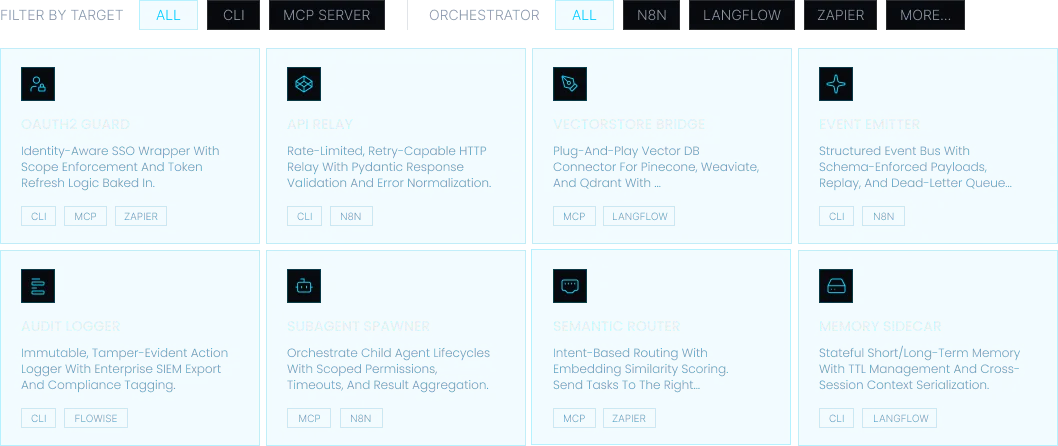


Yes, AI will write a ton of code, our initial components are all written by AI using the ComponentFactory.
But software isn’t just code, it’s the embodiment of the cumulative experience of all of its users. Each time software fails, or bumps into some corner case, or users provide feedback or suggestions, all of that experience gets baked back into the component making it better for all future users. Our ComponentFactory builds quickly, but the community makes it reliable, bug free, & secure.
Software developers NEVER truly start from scratch. They don’t build an agent by writing the BIOS → OS → DBs → libraries → frameworks → components → agent. They build on top of a software “stack” that frees them from all of that work. AI models are no different, they would rather assemble battle-tested components than build everything from the bottom up.
The problems arise when the higher-level components don’t quite address your needs. ComponentFactory solves this problem by building just-in-time components. These can be forked from proven components or completely new. These new components may require a code review and fix cycle, but then you can reuse them a thousand times, worry-free. Code reuse is a pseudo-religious mantra of software developers because it results in faster, more reliable code with fewer surprises. ComponentFactory is the engine for building the first version of new components, but our community turns them into the dependable building blocks powering the Agentic Age.
Both the ComponentCatalog (our growing library of increasingly validated, battle-tested components) and ComponentFactory (the tool to extend existing components or spin up new custom ones on the fly) are completely free to use.
Tokens cost money (because AI inference isn't free), so you'll need to bring your own model API key (OpenAI, Anthropic, Grok, etc.). Sadly, we do not get a piece of that sweet cash.
Want us to host ComponentFactory for you (cloud version, no local setup, always-on, managed updates)? That adds real costs on our end, so we charge a straightforward $9.95/month.
But if you prefer zero ongoing fees, just run ComponentFactory locally on your own computer—it's 100% free forever.
Bottom line: Core tools = free. Hosting convenience = small flat fee. We're here to help devs ship faster, not to gatekeep with pricing walls.
Your ability to generate income is core to why this ecosystem grows, we’re all-in on helping you turn skills into cash. Here are the main (and expanding) ways:
We’re constantly scheming more ways to help you monetize:
ComponentCatalog is your launchpad: contribute, fork, build rep, participate in sprints, and turn AI agent expertise into revenue streams. We win when you win.
Yes—absolutely, and we built it that way on purpose.
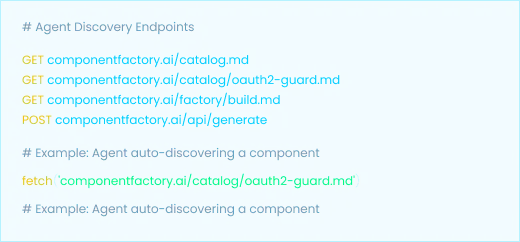
We expect most agents will actually be "subagents" (assembled and orchestrated by a higher-level agent), so we made everything super agent-friendly from day one:
We went the extra mile for OpenClaw (and its forks/derivatives): we created a ready-to-go skills file that makes ComponentCatalog and ComponentFactory plug-and-play. Drop it in, and your OpenClaw can browse the catalog, extend components, spin up new ones, and build agents—all autonomously.
If you're running OpenClaw to earn money by creating agents-as-a-service, we're 100% here for it. Use our free tools to crank out faster, more stable agents and charge whatever the market will pay.
Bottom line: Your agent isn't just allowed to use this stuff—it's designed to thrive with it.
Ideally, no—and that's by design.
Start with any component in the catalog that does most of what you need, then use Component Factory to fork it and tweak only the parts that matter.
You might still hit a small fix cycle on your custom bits, but it's way smaller than building from scratch—no reinventing the wheel, no massive debugging debt.
This is classic software wisdom: fork > rewrite. Extend proven foundations instead of starting over. Your agent gets exactly what it needs, faster, more reliably, and with far fewer "why is this breaking now?" moments. A friend once shared the following coder wisdom: “Coders are judged not on the code they write, but on the code they don’t have to write.”
Component Factory makes forking/extending dead simple and free (or $9.95/mo if you want us to host it).
Build smarter, not harder.
Easy—just check the badges displayed on each component in the catalog. They tell the full story at a glance.
Here’s how validation levels stack up:
Honestly? The community + sponsoring company validation often proves a component is truly bullet-proof—because thousands of real deployments beat any lab test.
Progeny View — Every component page also shows a Progeny section: this displays the full family tree of forks, extensions, and derivatives. You can see:
This transparency lets you trace exactly how battle-tested a component really is, follow the family tree to see how many real-world improvements and eyes have been on it over time.
Security note: To keep the catalog clean and reputable, contributors who want to publish or update components must verify their identity with uploaded ID. No ID needed if you’re just using components, only if you’re contributing, to maintain trust and quality.
Badges + Progeny make it crystal clear: more badges, deeper family tree, stronger contributors = more reliable. Pick wisely and ship faster, safer.
We’re actively expanding support because the more orchestrators we cover, the more devs (and agents) can benefit. Our prioritization is driven by:
If your favorite orchestrator isn’t on the list yet, tell us!
Even if we don’t add native support immediately, many orchestrators can still use our components via:
Worst case: fork an existing integration component and extend it yourself in Component Factory (free locally)—it’s designed exactly for this kind of “my tool needs a little custom glue” scenario.
We want ComponentCatalog to be the neutral, battle-tested foundation layer that works with whatever orchestrator wins your heart. Keep the requests coming—we’re motivated by what actually moves the needle for builders like you.
Got a tool you think we should prioritize? Hit us up.
A Component in our catalog is a self-contained, reusable building block designed for AI agents and workflows. It might be a discrete function, API call, integration, MCP server, whatever. It’s structured in four clear layers to make it powerful, portable, and future-proof:
This is where the real work happens: API calls, data processing, custom logic, tool usage, etc. It’s battle-tested through community use and fixes.
Metadata Layer (the documentation & contract) Everything an agent (or human) needs to understand and use it safely:
Together, these layers turn a simple function into a reliable, discoverable, interoperable, and evolvable asset—one that agents can assemble, fork, validate, and monetize. The goal: ship agents faster with far less custom glue code.
Want to see a real component breakdown? Browse the catalog or fork your first one.
In our system (and in modern AI agent / workflow tooling), a component and a container serve very different purposes—think "lego brick" vs "shipping box that holds multiple bricks."
Here's the clear breakdown:
In short:
Use components to build better, faster agents by assembling validated building blocks (fork one, tweak 10%, inherit 90% battle-tested goodness).
Use containers when you need to package and deploy an entire app, orchestrator, or service reliably across environments.
They complement each other: Run your agent orchestrator in a container, then feed it our lightweight components as tools/skills.
Components and OpenClaw skills complement each other.
Examples:
We created an OpenClaw skills file that teaches OpenClaw (or forks) how to search the ComponentCatalog, find, and use components in building subagents. It can also operate the ComponentFactory to fork existing components, or create new ones. This component generation can be done on the fly, enabling OpenClaw to add that missing functionality to make your subagent do exactly what you need. In short, it enables your OpenClaw to operate ComponentCatalog and ComponentFactory autonomously, turning it into a super-powered subagent builder.
Both power AI agents with external capabilities, but differ in depth and ecosystem.
Key advantages & integrations:
Quick Comparison:
They complement perfectly: Use components as battle-tested building blocks inside LangGraph agents, then trace everything in LangSmith.
Yes—that's exactly why we built them this way.
Components are designed as a neutral, foundational layer that works across orchestrators, so teams like yours can mix and match tools without rewriting logic every time. The only difference is in the Interface Layer, which is custom to each tool. So if a component already has a version in your tool you simply use it. If it doesn’t, you simply transcompile in ComponentFactory, which means build for the target tool. It inherits the battle tested foundation, but you’ll want to test and validate it on your tool. The best part is every time the component is validated on a new tool it gets better for other tools.
Bottom line: One validated, battle-tested component → reusable across your entire stack. No silos, less duplication, faster iteration.
Using multiple orchestrators already? Tell us which ones—let's get them on the roadmap.
