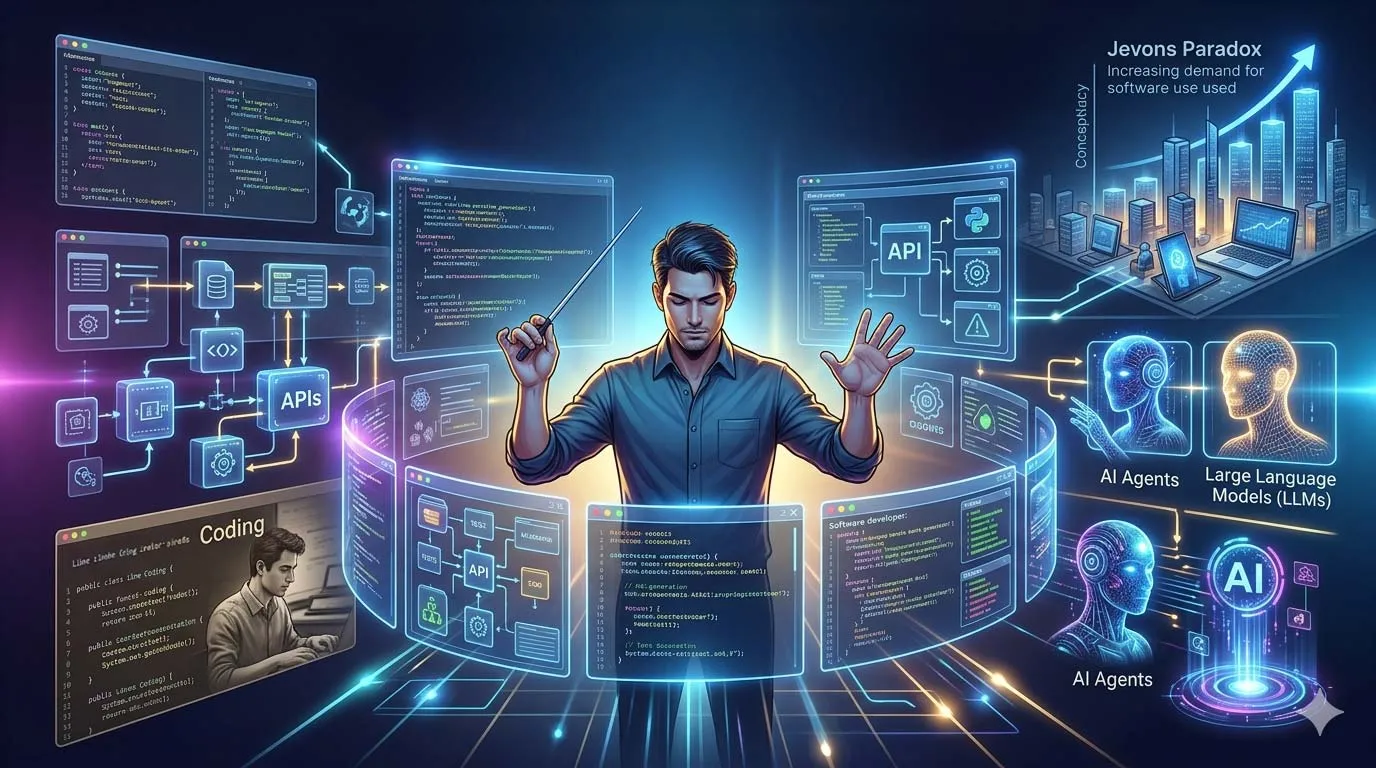
For the past few years, visual orchestration tools have been on a tear. Tools like n8n, Flowise, LangFlow, and Dify made it possible to build real systems without writing traditional code. You could drag nodes, wire logic, and stand up workflows that used to take weeks of engineering effort. That was a big deal. But there was still a catch. You had to think like a builder.
Visual tools lowered the barrier, but they didn’t remove it. To use them well, you still needed to understand:
Even in a no-code environment, you were still designing systems. That’s why most real deployments still relied on someone technical. Maybe not a full engineer, but definitely not a casual business user either. There was still a gap between the person who understands the problem and the person who can build the solution. Visual tools narrowed that gap. They didn’t eliminate it.
OpenAI Workspace Agents don’t start with steps. They start with intent; the goal. Instead of wiring nodes together, you describe what you want:
And the system figures out how to do it. No setup. No infrastructure. No canvas. No wiring. Just describe and go. That shift is easy to underestimate. It’s not just a better UI. It’s a different mental model. However, it’s a bit of a black box, you cannot see the logical chain of functions and review the components.
This is where things get interesting. Traditionally, software creation looked like this: (1) Users define problems; (2) Builders translate them into systems
Even with visual tools, that separation held. Workspace Agents collapse it. They create a new role. The hybrid. Someone who: (1) Understands the problem deeply; (2) Can articulate goals clearly; (3) Doesn’t need to manually construct the system.
This isn’t “non-technical users building software.” It’s something else entirely. It’s people operating at a higher level of abstraction.
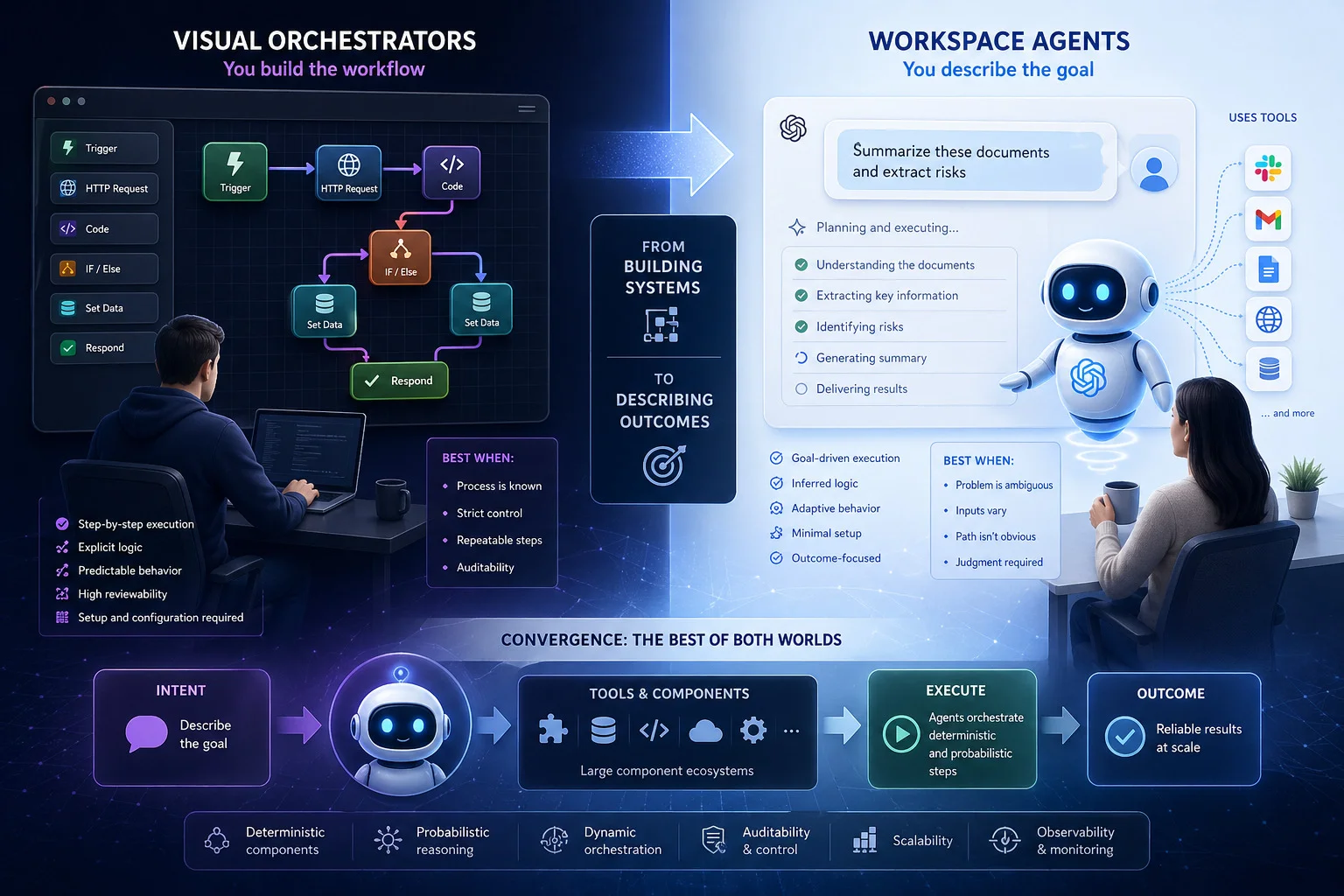
Under the hood, this shift comes down to how these systems operate. Visual orchestrators are deterministic. Workspace Agents are probabilistic. Here’s the difference in practice:
| Visual Orchestrators | Workspace Agents | |
| Execution | Step-by-step | Goal-driven |
| Logic | Explicit | Inferred |
| Behavior | Predictable | Adaptive |
| Flexibility | Limited to design | Context-aware |
| Failure handling | Predefined | Dynamic |
| Setup Reviewability | Required High | Minimal Low |
With tools like n8n, you define: Step 1 → Step 2 → Step 3. With OpenAI Workspace Agents, you just define the outcome, and the system figures out how to get it done. That’s a big leap, but it jumps right over the ability to easily review and debug the steps. You have to trust that the model will get it right.
This isn’t a clean replacement story. It’s a shift in where each model fits.
Deterministic workflows (visual tools) are better when:
Examples:
Probabilistic agents are better when:
Think:
It’s convergence. Right now, they are dividing up a growing market. I fully expect them to merge, where the workspace agents embrace deterministic capabilities, just as some visual orchestrators have embraced probabilistic capabilities. They will meet in the middle. This will be especially important in landing enterprise customers who have big problems with probabilistic processes due to liability, regulations, maintenance, software supply-chain, certification, and more.
Visual tools are built around nodes. Each node performs a deterministic function. Agents already use something similar. Tools. The difference is who selects and orders the tool sequence. In visual orchestrators, it’s a human. In Workspace Agents, it’s the model. That’s a subtle but important shift. Instead of building the system, you’re enabling it.
We’re seeing early versions of this with platforms like Synta.io. They use models to select and assemble the tools for your n8n workflow, just like OpenAI does. But they still output deterministic systems. Workspace Agents go further. They don’t just generate workflows. They replace the need to explicitly define them.
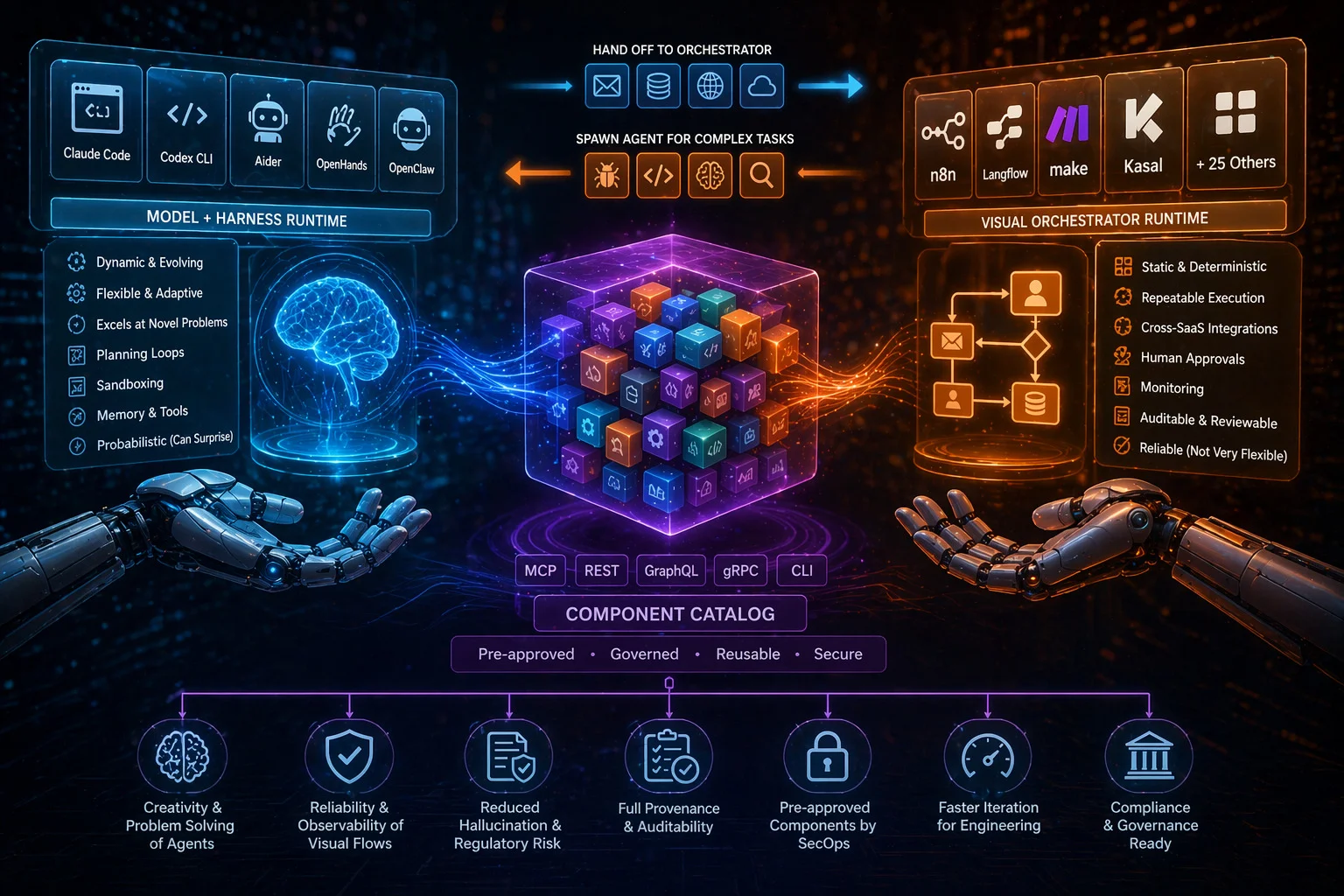
Now imagine combining this with large component ecosystems. ComponentFactory, for example, provides thousands of reusable components that can act like deterministic agentic building blocks. Workspace Agents can:
This gives you something new. A system that blends the deterministic execution (components) with probabilistic reasoning (models). Not as separate layers. As a single runtime.
Platforms like Dify and Kasal are already trying to bridge this gap. They combine structured workflows and AI-driven behavior. They sit in the middle. But if agents can:
Then the middle layer starts to disappear. The agent becomes the orchestrator.
The real disruption isn’t capability. It’s friction. Visual tools still require:
Workspace Agents remove almost all of that. That lowers the barrier to entry, anyone can build useful agents. And when more people can build, faster, with less effort, the market shifts quickly.
Visual orchestration isn’t going away. There will always be a need for deterministic systems, explicit control, and auditable workflows. But the center of gravity is moving. From designing systems step by step to describing outcomes and letting systems assemble themselves.
And in that shift, the line between user and builder doesn’t just blur. It disappears. The next wave won’t be defined by who can wire the best workflows. It will be defined by who can think clearly about problems and let intelligent systems do the rest.
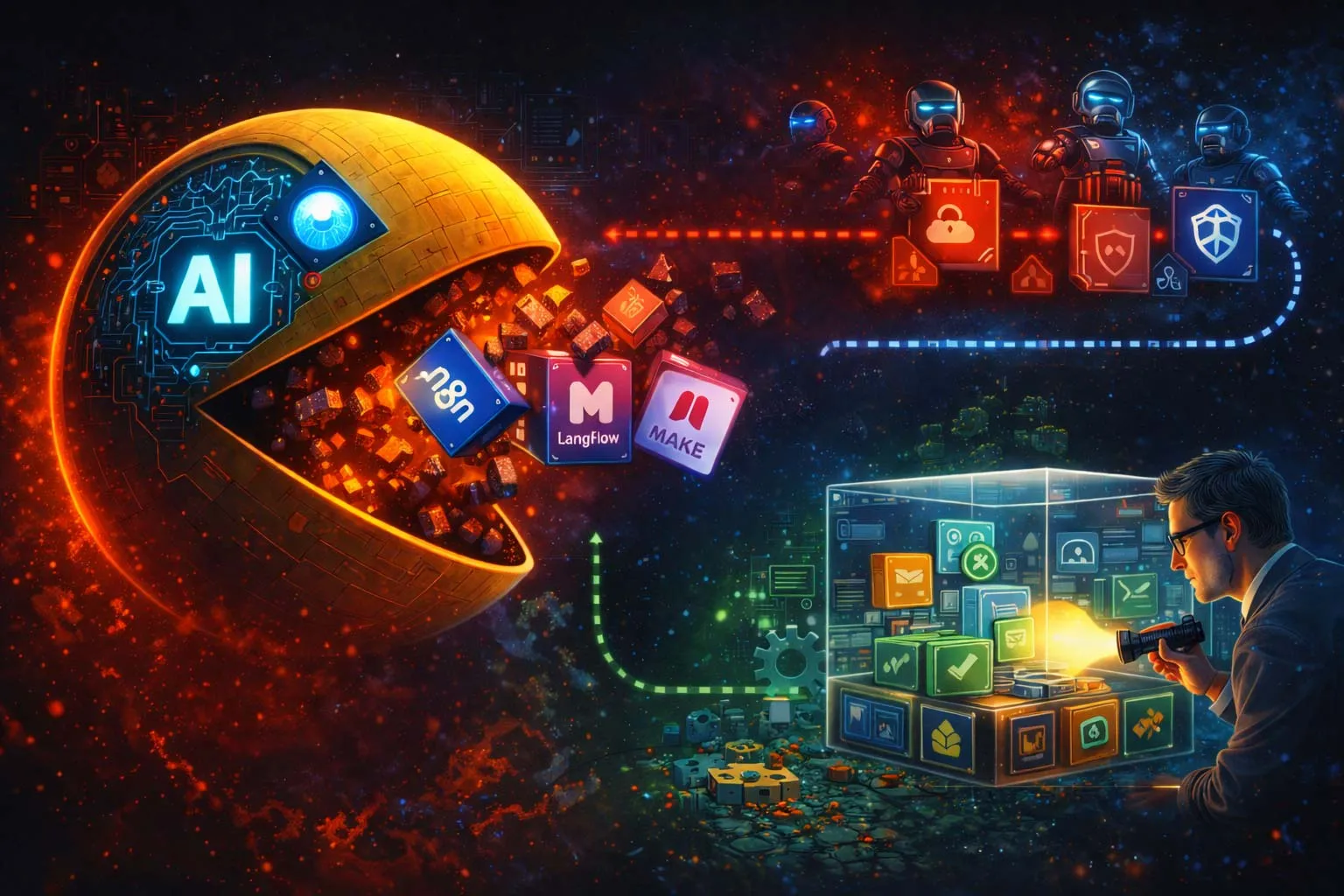
I would also note that there is a pattern in tech. Things often start as simplistic solutions, almost toys. Then they gain adoption and functionality. Then they challenge the big guys. Some describe this as the Saaspocalypse and it may be coming to the visual orchestrators who do not evolve to this blended reality or get acquired.
Like what you see? Share it with your friends.